Aportación realizada por Matt Bury

Imagen de Plugin developers

Just in case anyone's interested in this kind of thing:


Transfer appropriate processing in language learning: An essential principle
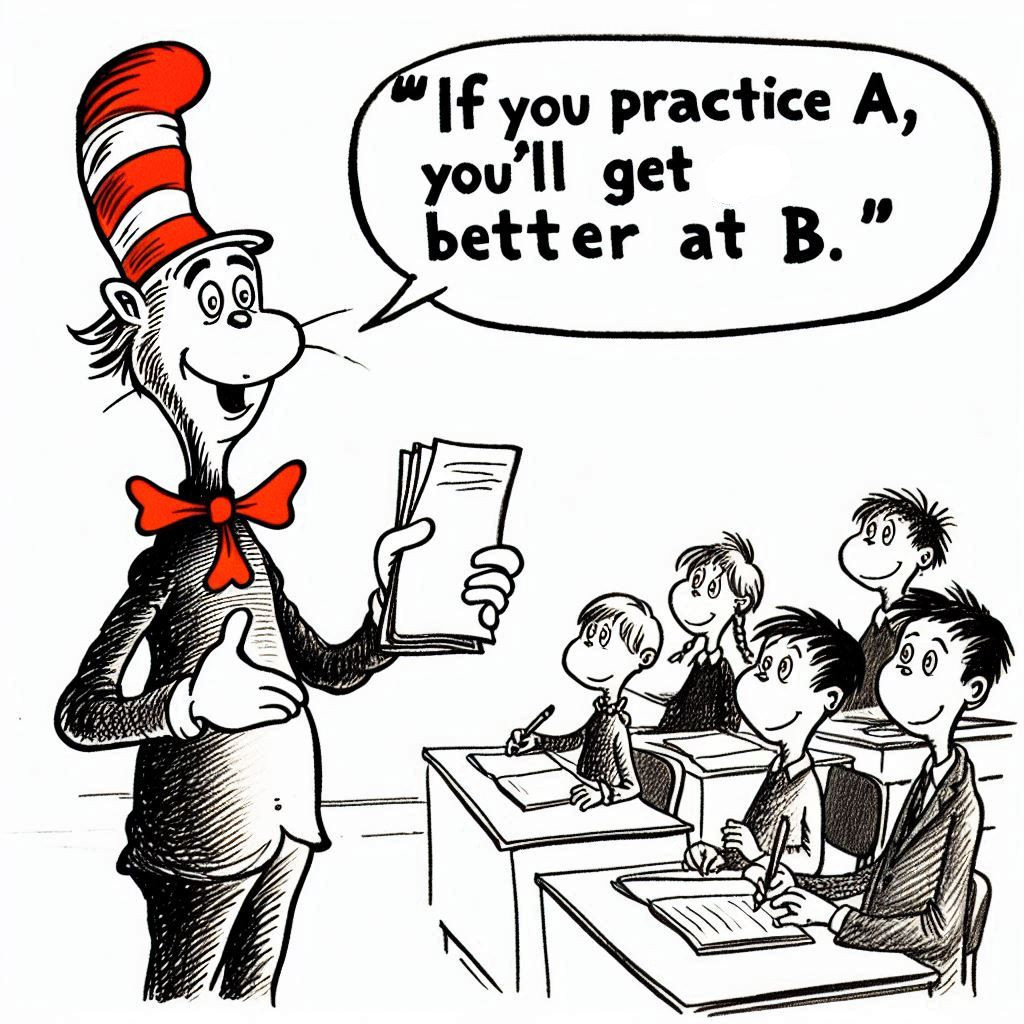
"If you practise A, you'll get better at B."

Introduction

Effective language learning means engaging in meaningful tasks that develop the knowledge, skills, & attitudes that are necessary for real-world communication. Transfer appropriate processing (TAP) is a fundamental principle in instructional design that ensures learning activities develop the competencies students need to participate in their target discourse communities. By aligning educational experiences with real-life language use, educators can create more useful and durable learning outcomes.

As instructional designers, curriculum developers, & teachers, our goal is to enable our students to participate competently in a wide variety of discourse communities. Discourse communities are groups of people that use language, in this case, English, in specific forms & specific ways in contexts such as the workplace, academia, leisure, & social integration.

For instance, professionals in the tourism & hospitality industry use particular language structures to coordinate work & provide customer service. Similarly, university students need to navigate lectures, academic readings, & social interactions using appropriate academic discourse. Even exam preparation classes, where students aim for certification, represent a (somewhat artificial) type of discourse community, requiring competencies that help them succeed in their exams.

Competencies are complex configurations of knowledge, skills, & attitudes. In language learning, communicative competencies – comprising these elements – is the primary objective. Our intention is to design learning activities that help to develop these competencies through appropriate & meaningful engagement with texts & discourse, a process central to transfer appropriate processing (TAP). TAP is fundamental in instructional design, curriculum development, teaching, & learning because it ensures that what our students practise in class effectively transfers to authentic use in real-world contexts.

The challenge of language classrooms

A major challenge in language education is that typical classrooms do not always reflect the discourse environments & communities that our students need to function in. The types of interactions & language used in classrooms often differ from those in professional, academic, or social settings. Consequently, educators must design substitute activities that engage our students in processing language in ways that facilitate participation in real-world discourse communities.

Some effective TAP activities may seem counter-intuitive. Activities that effectively help to develop knowledge, skills, & attitudes may look quite different from the competencies our students eventually need to master. The aim is to ensure that our students engage deeply & for sustained periods in meaningful tasks that process meaning & language appropriately, & develop their ability to use language in their target discourse communities.

The role of instructional design in TAP

More mature students are often sensitive to how well a given learning activity may contribute to their language learning goals. When they understand the rationale behind an activity, they are more likely to engage more purposefully & effectively. Therefore, teachers & curriculum developers must be well-informed about how language acquisition happens & how specific learning activities contribute to language development in order to convey this to our students & guide them during language development activities more effectively.

To optimise instruction, we need to identify activities that offer the most effective transfer appropriate processing. This requires a deep understanding of the affordances, constraints, & risks associated with different teaching & curriculum design techniques, strategies, & approaches.

The importance of research in TAP

How can we be sure that particular learning activities contribute to competency development? The answer lies in well-designed research. Scientific evidence provides the best insights we have into effective learning strategies.

For example, does reading & listening to meaningful, comprehensible input improve language competencies? Research overwhelmingly supports this as an essential component of language acquisition. Extensive reading & listening are not only beneficial but also a low-risk strategy that optimises language learning across various contexts.

Conversely, do mechanical grammar exercises, such as conjugating verbs in isolated sentences, AKA “pedagogical grammars,” enhance communicative competence? Research indicates that while such activities may improve performance on discrete grammar tests, they offer little to no benefit in real-world language use. These exercises lack transfer appropriate processing, meaning the skills practised do not transfer well to actual language use.

A more complex question is whether guessing the meaning of words from context supports language development. The answer depends on several factors. For instance, it may be effective if our students already understand at least 98% of the surrounding text (the co-text), ensuring that too many unfamiliar words do not disrupt overall comprehension. However, to further complicate things, ambiguous or counter-intuitive language may lead to misunderstandings, requiring teacher intervention. In some cases, enhancing the text with inline glossaries or brief clarifications can improve learning outcomes.

Conclusion

Transfer appropriate processing is a critical concept in instructional design, curriculum development, & teaching. Ensuring that learning activities align with the competencies our students need in their target discourse communities enhances language development & improves student motivation. By relying on research-informed techniques, strategies, & approaches, we can optimise instructional strategies & provide our students with useful, meaningful, & transferable language competencies. Understanding & implementing TAP principles enables us to design more effective curricula, creating learning experiences that truly prepare our students for real-world language use.

Published 8 February 2025

Link to original: https://matbury.com/wordpress/index.php/2025/02/08/transfer-appropriate-processing-in-language-learning-an-essential-principle/

Copyright notice

All original works on this site by Matt Bury are licensed under Creative Commons Attribution-NonCommercial 4.0 International

I, Matt Bury, hereby declare that no content on this site may be used for Artificial Intelligence, machine learning, &/or training algorithms of any kind.


Promedio de valoraciones: -

Moodle in English -> Lounge -> Come and Join Mastodon -> Re: Come and Join Mastodon

de Matt Bury -
Imagen de Plugin developers

I've been a lazy boy & simply asked ChatGPT to compare & contrast Xitter, Bluesky, & Mastodon. It produced a nice summary which is pretty much what i read & heard elsewhere, although I disagree that there's any middle ground because once a platform reaches a critical mass of users, as we've seen from Xitter, it's very difficult to transition to another. Anyway, here it is:

Bluesky is relatively open in terms of its structure, but it has some practical limitations compared to Mastodon. Here’s a breakdown of how it compares to Twitter/X and Mastodon:

Openness of Bluesky

  • Federation Model: Bluesky is built on the AT Protocol, which supports federation, meaning different servers (or "hosts") can exist. However, as of early 2024, federation is still in its early stages, and most users are on the main Bluesky-operated server.
  • Moderation and Censorship: While users can choose different moderation services and custom algorithms, Bluesky’s main server still controls a significant portion of content visibility.
  • Access and Sign-ups: Originally invite-only, Bluesky is now open to the public, making it more accessible than before.

Comparison with Twitter/X

  • Centralization: Twitter/X remains a fully centralized platform controlled by a single company (Elon Musk’s X Corp.), whereas Bluesky is working toward decentralization.
  • Algorithm Control: Twitter/X decides what content appears in feeds through its opaque recommendation system, while Bluesky allows users to pick different algorithms to shape their experience.
  • Verification and Identity: Twitter/X uses a paid verification model, whereas Bluesky has decentralized identity support via “handles” and domain-based usernames.
  • Moderation: Twitter/X has been criticized for its inconsistent moderation policies, while Bluesky aims to provide more user control, though it still relies heavily on centralized moderation.

Comparison with Mastodon

  • Decentralization: Mastodon is fully federated through the ActivityPub protocol, meaning there are thousands of independent servers, while Bluesky’s federation is still limited.
  • Server Choice: Mastodon users have a much broader choice of instances, whereas Bluesky users are mostly confined to the main server for now.
  • Ease of Use: Bluesky’s interface is simpler and more user-friendly than Mastodon, which has a learning curve due to its decentralized nature.
  • Content Discovery: Bluesky’s approach to algorithmic feeds makes it easier to discover content, whereas Mastodon’s structure can make finding engaging content or people harder.

Final Thoughts

Bluesky is more open than Twitter/X in terms of decentralization and user control but is not as fully federated or independent as Mastodon. It’s currently in a transitional phase where it offers some decentralized features but is still dependent on its main server. If you want the full experience of decentralized social media, Mastodon is the better option, but if you’re looking for something easier to use while still moving away from Twitter/X, Bluesky might be a good middle ground.

___AND___

The likelihood of "corporate enshittification"—where a platform degrades over time due to profit-driven decision-making—varies across Twitter/X, Bluesky, and Mastodon based on their structure, funding, and governance models. Here’s how they compare:


1. Twitter/X: Extremely High Likelihood

Why?

  • Fully centralized & privately owned: Elon Musk controls Twitter/X, and decisions are made based on business interests, often with little regard for user experience.
  • Profit-driven model: The platform prioritizes ad revenue, subscription services (Twitter Blue/X Premium), and algorithmic visibility manipulation.
  • Degraded user experience: Since Musk’s takeover, we've seen reduced moderation, paywalled features, increased spam, and algorithmic manipulation favoring paying users.
  • Data exploitation: Twitter/X has pushed aggressive data collection, API restrictions, and monetization of basic functionalities.

Verdict: Already enshittified and likely to get worse.


2. Bluesky: Moderate to High Likelihood

Why?

  • Venture-backed startup: Bluesky started with Twitter funding and later took VC investment, which raises the risk of profit-driven compromises.
  • Centralized control (for now): Most users are still on Bluesky’s main server, meaning the company holds significant power over moderation and governance.
  • Potential for monetization creep: While Bluesky has promised openness, the need to sustain its business model could lead to decisions that prioritize revenue over user experience (e.g., ads, paywalled features, algorithmic manipulation).
  • Custom feeds mitigate some risks: Unlike Twitter/X, Bluesky allows users to choose different algorithmic feeds, reducing the platform’s ability to control visibility completely.

Verdict: Could enshittify if VC pressures push it toward profitability at the expense of openness, but decentralization efforts may slow this down.


3. Mastodon: Low Likelihood

Why?

  • Nonprofit structure: Mastodon gGmbH (the main Mastodon development org) is not VC-backed, reducing pressure for profit-driven changes.
  • Fully decentralized: No single entity controls Mastodon. Each server (instance) is independently run, meaning there’s no universal algorithm or monetization scheme.
  • No incentive for enshittification: Since many Mastodon instances are community-run, there’s no strong financial pressure to degrade the experience.
  • Some risks: Individual Mastodon instances could introduce bad policies (e.g., ads, data exploitation), but users can easily move to a different instance.

Verdict: Least likely to enshittify, though individual instances may vary.


Overall Likelihood of Enshittification (Ranked Most to Least Risky)

1️⃣ Twitter/X (100% enshittified and getting worse)
2️⃣ Bluesky (Moderate risk, depends on decentralization progress and business model)
3️⃣ Mastodon (Lowest risk due to nonprofit, decentralized nature)

If avoiding enshittification is your main concern, Mastodon is the safest bet. Bluesky might stay user-friendly if it remains committed to decentralization, but VC pressure could eventually push it toward monetization schemes. Twitter/X, on the other hand, is already deep in the enshittification process.

Promedio de valoraciones: Coolest thing ever! (4)
Imagen de Plugin developers

No worries, Marcus. I didn't think you were, I only meant to clarify the ambiguity about international jurisdictions & differences in copyright laws.

I'm not that well-informed, legally speaking, but what intrigues me is that if AI generated media aren't copyrightable, then does that make them derivative works & subject to the copyright on the original works from which they were generated?

As far as I understand it, that seems to be the idea behind the legal challenges that creatives & copyright holders are pursuing in various courts.

Promedio de valoraciones: Coolest thing ever! (1)
Imagen de Plugin developers

There's a fair amount of international coordination on copyright laws & interpretation. That's not to say that they're in lock-step but they tend to broadly follow the USA, though often not in detail. See: https://en.wikipedia.org/wiki/World_Intellectual_Property_Organization
Imagen de Plugin developers
More effective proctoring & ending open book assignments & exams is becoming more common, as far as I understand it. It'd seem that preventing students from being able to submit GPT LLM generated text is broadly seen as an effective strategy.

It's also my understanding that many university curricula under-prepare & overload students with work to a point where they have to make choices between what to study & what to ignore. See Graham Gibbs' short essay on this topic: https://web.archive.org/web/20160405133040/http://seda.ac.uk/resources/files/publications_175_26%20Students%20are%20selectively%20negligent,%20and%20successful%20students%20neglect%20the%20right%20stuff.pdf In other words, many students turn to academic malpractice as a survival strategy. I doubt any amount of persuasion or guidance will convince such students not to take what they see as necessary shortcuts.

Is it that GPT LLMs are exposing deeper issues in higher education, which have always been there & have always provided advantages for those who can provide ways to game the system in their favour? I very much doubt that the solutions will be found in yet more algorithms.
Promedio de valoraciones: Coolest thing ever! (2)